
Last updated October 30, 2026
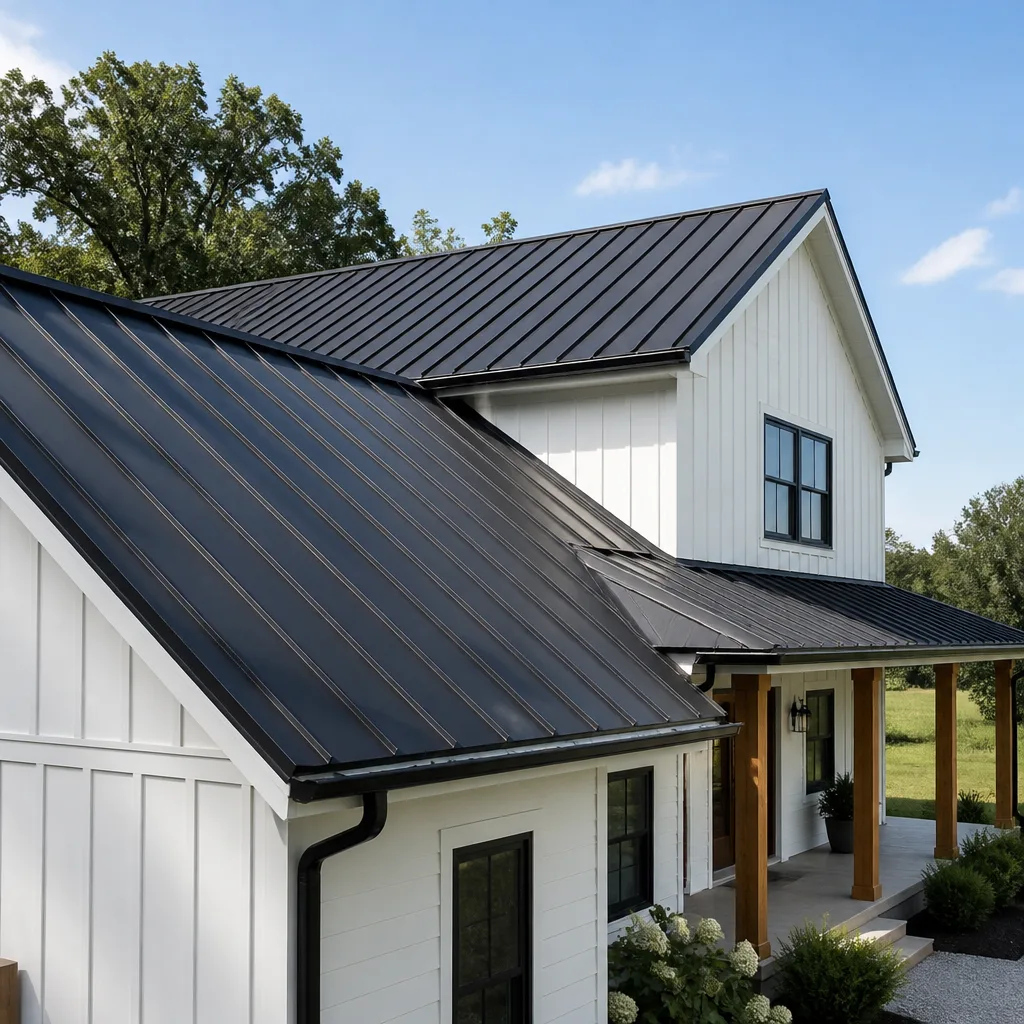 Metal roofing
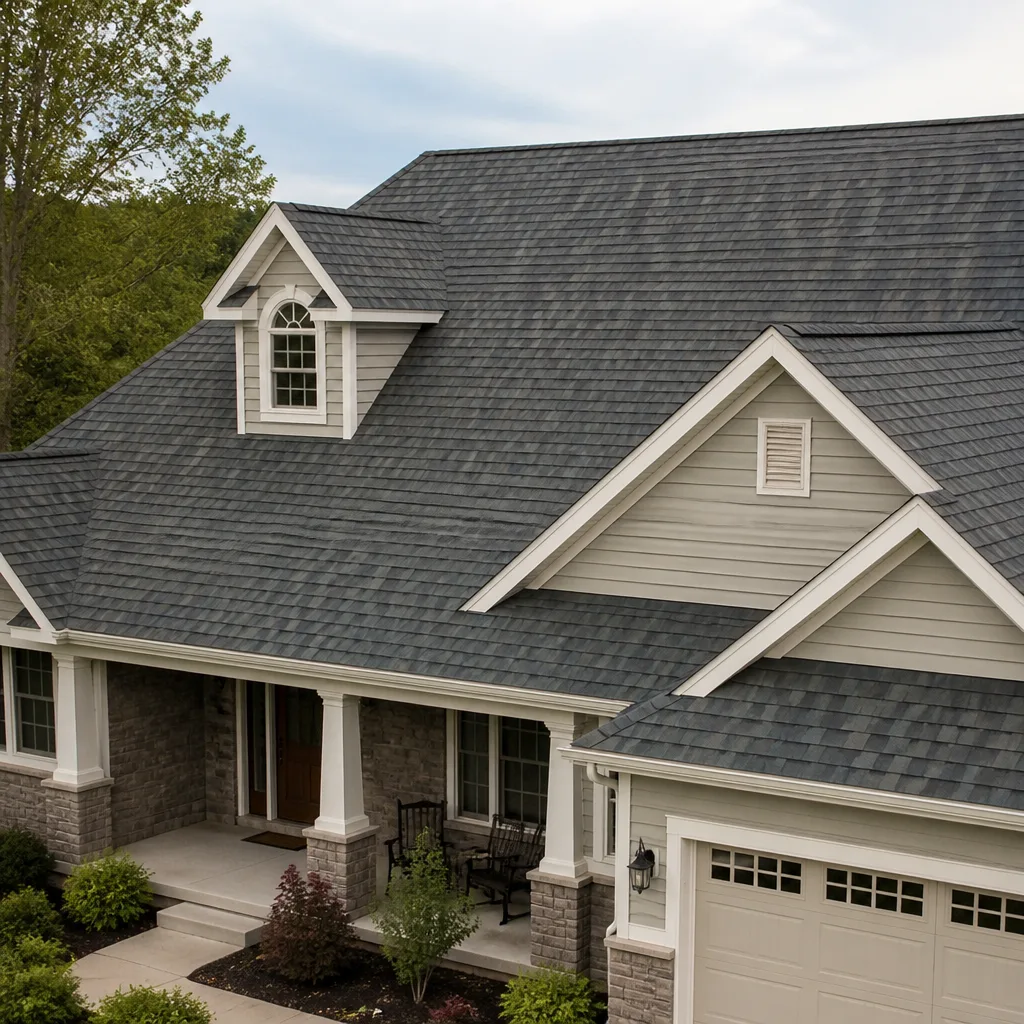 Architectural shingles
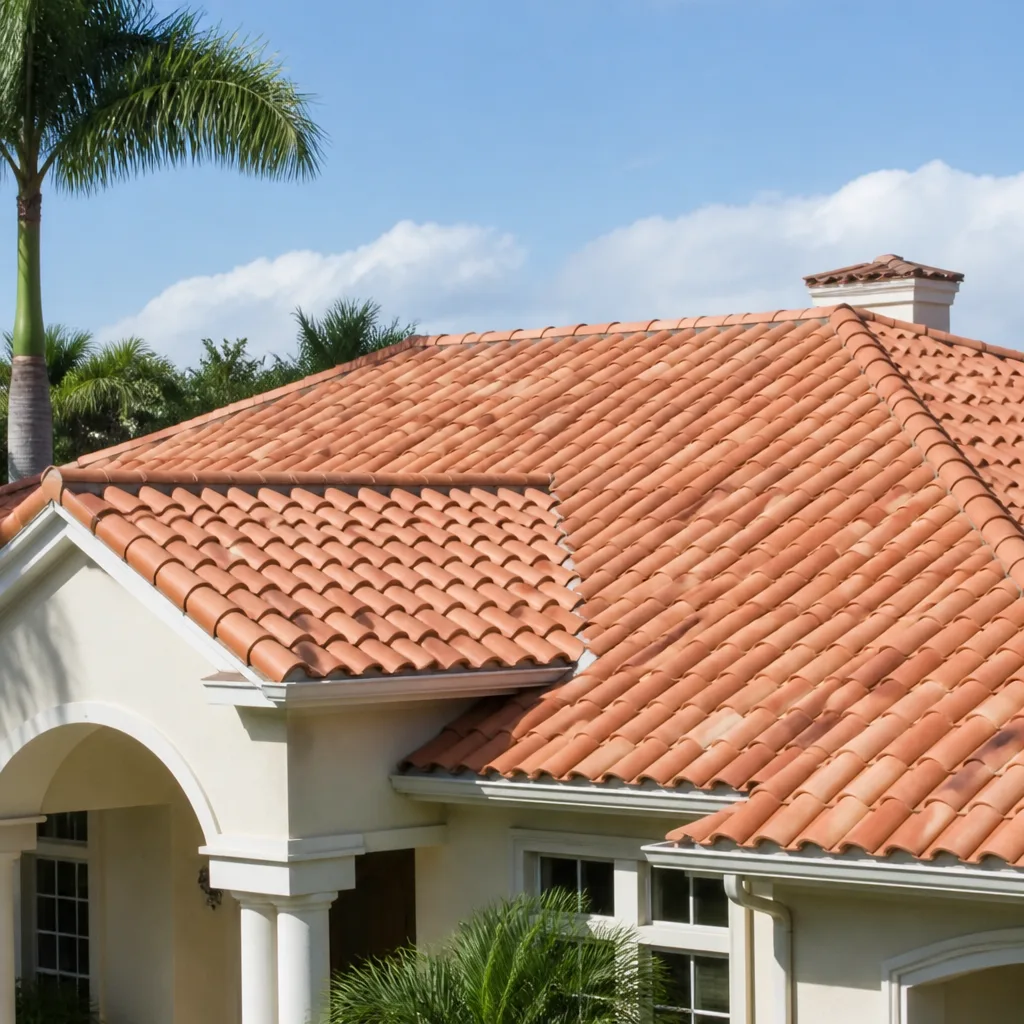 Tile roofing
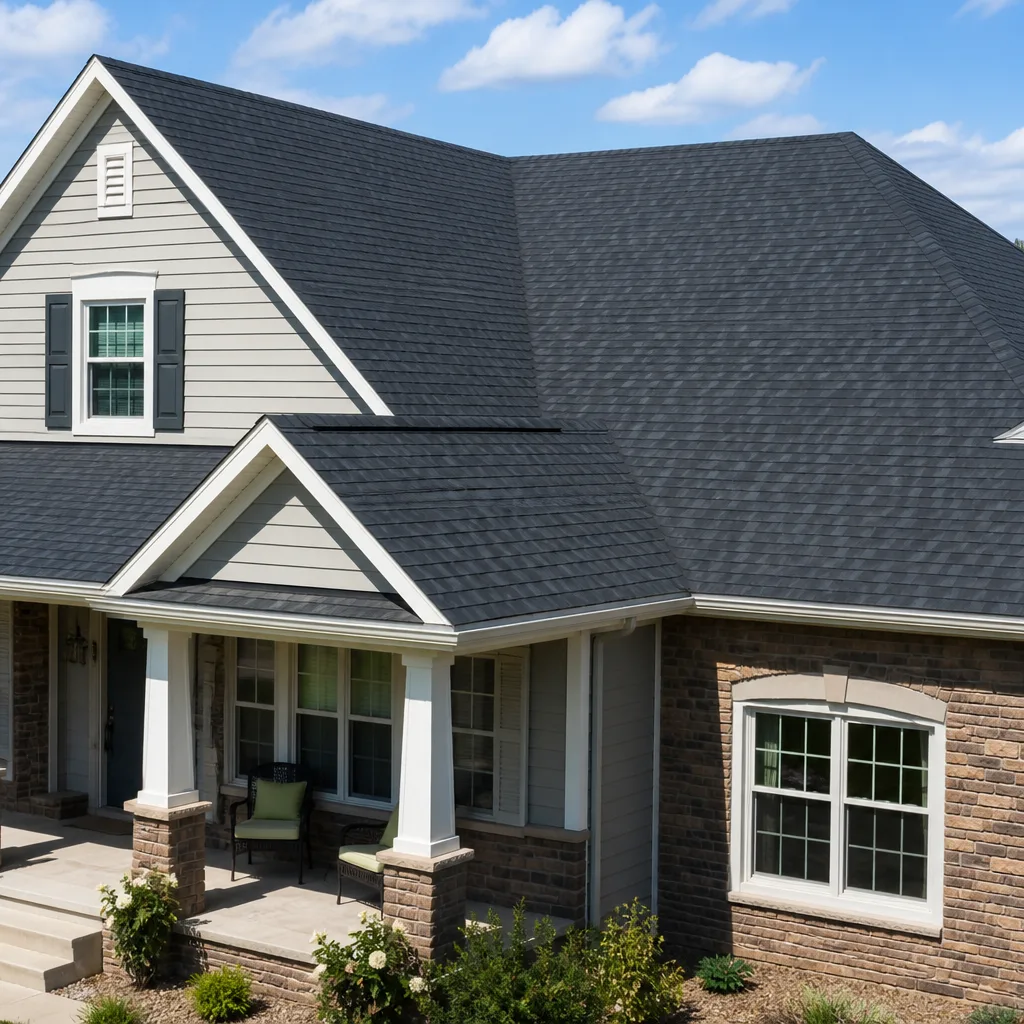 GAF
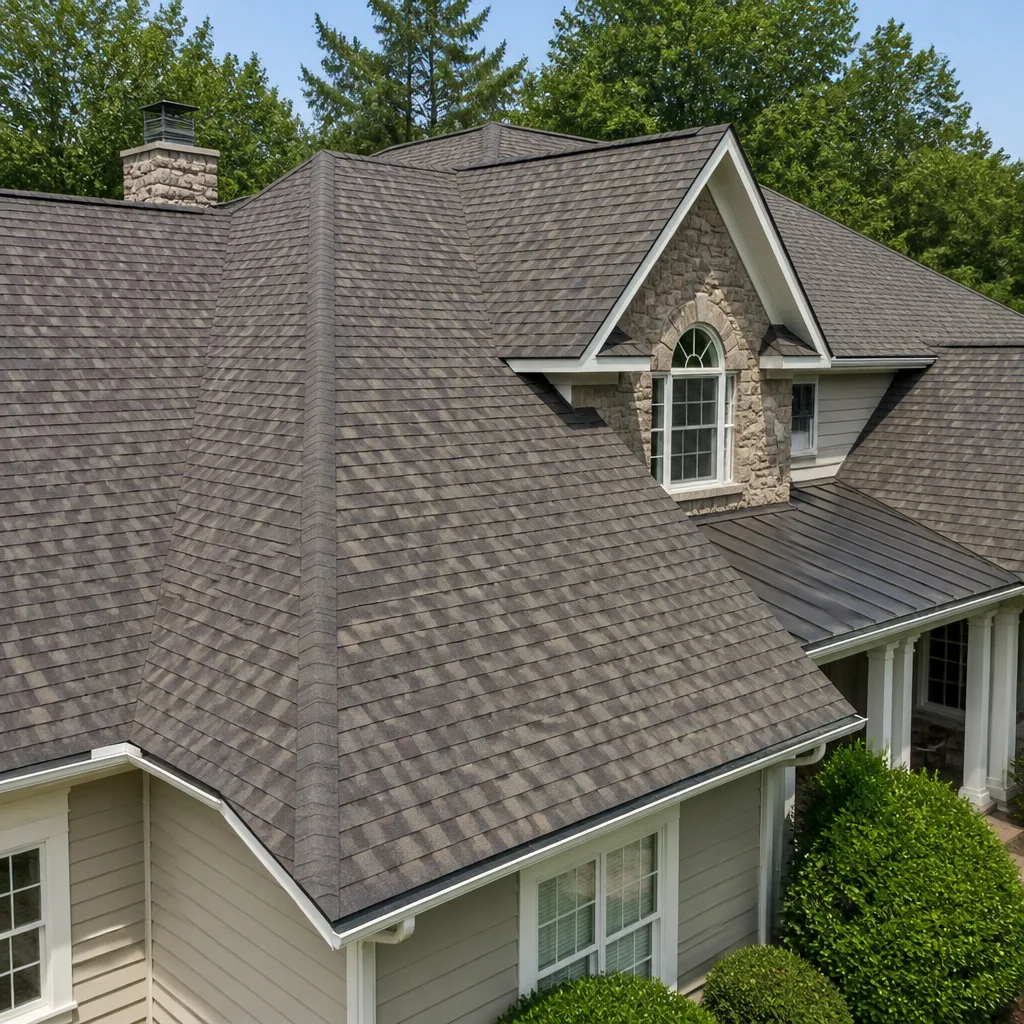 Owens Corning
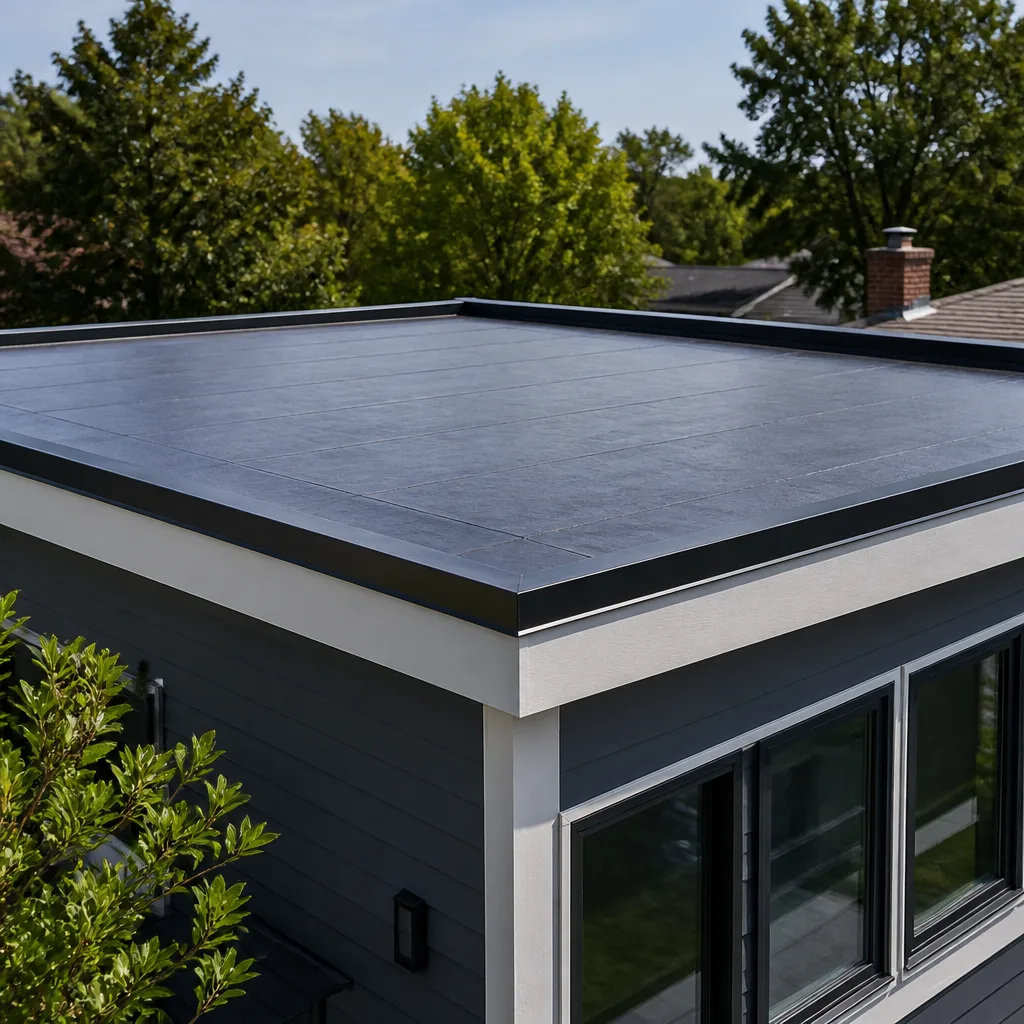 Flat & low-slope
Free roof inspection with deck photos before we talk money - GAF and Owens Corning certified installation
How to Hire a Roofing Contractor in Koreatown: A Step-by-Step Guide
Any contractor can pass a license lookup. What you actually need to know is whether they’ve pulled a permit at LADBS in the last 12 months and whether they’ve worked on a building with a shared party wall, because most haven’t. Koreatown’s roofscape doesn’t look like the rest of Los Angeles. You’ve got 1920s Spanish duplexes butted against 1980s stucco apartment blocks. You’ve got flat roofs with drains that clog every December. You’ve got parapet walls that crack and let water run behind the stucco. A roofer who learned his trade in the Valley on wide-lot single-family homes will find himself lost on a Wilshire-adjacent property line. This guide walks you through how to vet a roofing contractor in Koreatown the way someone who actually works here would, covering permits, urban job-site logistics, bid comparison, and the questions that reveal whether a contractor has done this work in th For more guides & resources, visit our blog.is neighborhood before.
Quick Answer
To hire a roofing contractor in Koreatown, verify their CSLB license, then check their actual LADBS permit history for the last 12 months. Ask specifically about party-wall experience, street use permits, and debris disposal logistics, because urban Koreatown job sites have constraints that suburban roofs don’t. Then compare bids using manufacturer tier normalization rather than bottom-line price, and confirm whether the crew doing the work are employees or subcontracted labor.
Styles & brands we work with
Table of Contents
- Step 1: Verify the License and the LADBS Permit History (Not Just the License)
- Step 2: Interrogate Their Urban Job-Site Competence
- Step 3: Understand the Roofing-Only Specialist vs. General Contractor Distinction
- Step 4: Identify Koreatown-Specific Red Flags Before You Sign
- Step 5: Compare Bids With a Manufacturer-Tier Framework
- Step 6: Ask the Subcontracting Question Directly
- Step 7: Know What a Legitimate Koreatown Roofing Job Requires
Step 1: Verify the License and the LADBS Permit History (Not Just the License)
The CSLB license check is table stakes. Every legitimate contractor in California carries one. The number you should actually care about is what shows up when you search the contractor’s permit history at LADBS, the Los Angeles Department of Building and Safety. A roofing contractor who has pulled permits at LADBS within the last year knows what LA inspectors look for. They know the counter staff. They know how long plan check takes for a reroof on a pre-1970 building. They know that Koreatown’s older housing stock, much of it built between 1920 and 1960, often triggers additional review because original construction methods don’t always map cleanly onto current code.
Here’s how to check, step by step:
- Confirm the CSLB license is active. Go to the CSLB website, enter the license number, and verify the name on the license matches the name on the contract. Then check the CSLB’s “Worker’s Compensation” field. If it says “none,” that’s a problem in California, because roofing crews must be covered.
- Ask the contractor for their LADBS permit numbers. Any contractor who has worked in Los Angeles recently should be able to produce permit numbers for jobs they’ve completed. Not “I think we did one in Silver Lake.” Actual numbers you can look up.
- Look up the permit at LADBS’s Building Records system. Type the address into LADBS’s online portal and see what comes back. Was the permit finaled? An open permit is a lien on the property. An unfinaled roof permit means the inspector never signed off, and now you own that problem when you sell.
- Ask about Koreatown-specific code issues. The neighborhood has a lot of flat and low-slope roofs. Those require specific drain calculations, overflow scupper requirements, and in many cases, a cool-roof or Title 24 energy compliance depending on the scope. A contractor who hasn’t dealt with those in Koreatown won’t know to flag them.
The point isn’t that LADBS experience makes someone a better roofer. It’s that LA’s inspection process is its own animal. A contractor who avoids it or doesn’t understand it will eventually put you in a position where the city issues a correction notice, and the job stalls.
Step 2: Interrogate Their Urban Job-Site Competence
Koreatown is one of the densest neighborhoods in Los Angeles. That’s not incidental to a roofing job; it’s the defining variable. The roof on a building at Western and 8th sits maybe four feet from the roof on the building next door. If a contractor tears off the old roof and chunks of old asphalt land on your neighbor’s skylight, you’re now in a liability situation that has nothing to do with your roof and everything to do with your contractor’s operational discipline.
Here are the questions that reveal whether a roofer has actually worked on urban Koreatown sites, not just suburban driveways:
- “How do you handle debris disposal on a street with no staging area?” A dumpster that requires a street use permit is not the default. Many Koreatown streets are narrow, some have parking restrictions, and a dumpster on Wilshire or Olympic requires an actual permit. A contractor who says “we’ll figure it out” has not figured it out before, or they have and the job got expensive.
- “Will you need a street use permit for this job?” The answer varies by location. A contractor who knows LA will explain the conditions under which a permit is required, and the conditions under which it isn’t. A contractor who stares blankly is about to learn on your dime.
- “How do you handle shared party walls?” This is the Koreatown question. Many buildings in the neighborhood share a wall with the building next door. That wall extends up to the roofline and sometimes above it. Roofing work that meets that wall requires care: flashing details, neighbor notification, and sometimes access to the neighboring property. A contractor who has done this in Koreatown will have an answer. A contractor who hasn’t will say “we don’t need to touch the wall,” which is how you get leaks at the wall-roof junction six months later.
- “What’s your notification protocol for neighbors?” In a dense neighborhood, a roofing job is loud. It starts early. It generates dust. A contractor who notifies adjacent units in advance, ideally in the language the neighbors actually speak, is one who has learned that Koreatown buildings are frequently managed by third-party property managers who may communicate in Korean or Spanish. That’s not a diversity talking point; it’s an operational requirement for a job that goes smoothly.
These questions are not optional extras. A roofing contractor who can answer them clearly has done urban work. One who can’t has done the roof equivalent of easy mode, and you’re about to pay for their learning curve.
Step 3: Understand the Roofing-Only Specialist vs. General Contractor Distinction
There’s a reason Koreatown Roofing does roofing and nothing else. A general contractor who lists roofing among fifteen services is running a business structured around customer acquisition, not trade depth. When a GC lands a kitchen remodel, they don’t put their best crew on the roof. Roofing is filler work. It’s the thing they do between bigger jobs, often with whoever is available, often subcontracted out to a crew the GC has never worked with before.
A roofing-only contractor has no off-season. Every job is a roof. The estimator who walks your roof is the same person who has walked five other roofs that week in the same neighborhood. The crew lead has done nothing but roofs for years. That concentration shows up in small ways: they recognize that a certain type of stain pattern at a parapet wall junction is a flashing failure, not a membrane failure. They know which Koreatown-era buildings have original cedar shakes under a later composition overlay because they’ve torn into them before.
Ask directly: “Is roofing your primary trade, or is it one of several services you offer?” Then listen for the pause. A legitimate answer from a specialist is immediate: “Roofing is all we do. Inspection, repair, replacement. That’s the whole list.” A GC will hedge. “We do roofing, yeah, but we also do kitchens, baths, additions…” That’s an honest answer, but it’s also the answer you should walk away from for a roof.
There’s also the subcontracting angle. When a GC takes a roofing job and subs it out, you now have two separate parties with two separate incentives. The GC wants to hold margin. The sub wants to finish fast and get paid. Your roof is the point where those incentives meet, and that’s exactly where problems land.
Step 4: Identify Koreatown-Specific Red Flags Before You Sign
Every market has its own scams. Koreatown’s are shaped by the neighborhood’s rental density, its aging housing stock, and its position as a target for out-of-town operators after big weather events. Here’s what to watch for.
The “we’ll waive the permit as a favor” contractor. This one is everywhere in LA, but it’s dangerous in Koreatown specifically because so much of the housing stock is older and rental. When you sell a property or refinance it, the lender may ask about permit history. An unpermitted reroof can kill a sale or force you to retroactively pull a permit, pay double fees, and fix whatever the inspector now wants fixed. A contractor who offers to waive the permit isn’t doing you a favor. They’re avoiding the inspection because they don’t think their work will pass. Walk away.
The El Niño storm-chaser. After a wet season, out-of-state crews show up in Koreatown with magnetic signs on their trucks and a pitch about “storm damage.” They’re gone by June. Their repairs fail by October. Check the CSLB license, check the business address (a P.O. box in Nevada is not a Koreatown roofer), and ask how long they’ve been doing work in Los Angeles specifically. If the answer is vague, you’re looking at a storm-chaser.
The “we have a crew in the area” contractor. This is the same bait with different packaging. A contractor knocks on your door, says they noticed damage, and mentions they have a crew working on a house two blocks away, so they can give you a special rate if you sign today. Legitimate roofing contractors do not go door to door. They don’t use “we’re in the neighborhood” as a pricing mechanism. This is a script, and it’s a pressure tactic.
Unlicensed crews posing as employees. A contractor presents himself as the operator, then shows up on day one with a crew of “his guys” who are actually day laborers the contractor has never met. Ask before you sign: “Is this crew on your payroll, or are they subcontracted?” In California, workers’ compensation responsibility follows the direct employer. If the crew isn’t covered and someone falls off your roof, you may be dragged into a claim. This is not hypothetical. It’s one of the most common insurance disasters in LA residential construction.
Step 5: Compare Bids With a Manufacturer-Tier Framework
When you get three bids for a reroof in Koreatown, one will quote GAF. Another will quote CertainTeed. A third will quote a no-name membrane and say “it’s the same thing.” It is not the same thing. Here’s how to normalize those bids so you’re comparing apples to apples.
Roofing materials exist in tiers. Top-tier shingle manufacturers include GAF, CertainTeed, Owens Corning, and IKO. Mid-tier manufacturers include brands you’ll find at national distributors under names that sound similar but aren’t. Budget-tier products are what you get from a contractor who says “the shingles don’t matter, the install matters.” Install matters, but so does the shingle. A budget shingle from an off-brand manufacturer may be 20% cheaper up front and fail five years earlier in Koreatown’s UV and smog exposure.
The framework we recommend to our customers is this:
- Write down the exact product name and model from each bid. Not “premium architectural shingle.” The actual name. If a bid doesn’t specify a manufacturer and model, it’s not a bid, it’s a guess.
- Group the bids by manufacturer tier. Top-tier (GAF, CertainTeed, Owens Corning, IKO, Atlas, Tamko, Boral) should be compared against each other. Mid-tier against mid-tier. Budget against budget.
- For top-tier bids, check the warranty structure. Many top-tier manufacturers offer enhanced warranties only when the contractor is certified by that manufacturer. Ask: “Are you certified by this manufacturer, and does this bid include the enhanced warranty?”
- Lay the installation scope side by side. Underlayment type, ice and water shield placement, flashing details, ventilation. A cheaper bid often strips out the line items that don’t get visible until the roof leaks.
- Compare labor cost as a separate line from materials. A bid with top-tier materials and suspiciously low labor will get you a rushed install. A bid with budget materials and high labor is wrong too. What you want is transparent separation, so you can see what you’re actually paying for.
Koreatown Roofing works with seven manufacturers, including GAF, CertainTeed, Owens Corning, and IKO. That doesn’t mean we’re indifferent to which one you choose. It means when a customer asks us “which shingle should I buy for a 1940s Spanish duplex with a low-pitch roof,” we can recommend based on the roof, the budget, and the neighborhood, not based on what we happen to have in the warehouse. Your roof, your material choice. That’s the principle.
Step 6: Ask the Subcontracting Question Directly
This is the single most useful question you can ask a roofing contractor, and almost no one asks it. It’s: “Who exactly will be on my roof, and are they your employees?”
There are three possible answers:
- “Our own crew. They’re employees.” This is what you want to hear. It means the contractor has direct control over scheduling, workmanship, and accountability. If something goes wrong, there’s one phone number and one responsible party.
- “We use a subcontractor we’ve worked with for years.” This can be fine, but you need to follow up. “Who is the sub? What’s their license? Are they covered by your workers’ compensation policy?” If the contractor won’t provide the sub’s license and insurance certificate, something is off.
- “We use whoever’s available.” This is the answer that ends the conversation. A contractor who can’t tell you who will be on your roof doesn’t have operational control, and without operational control, they can’t protect you or the job.
At Koreatown Roofing, 100% of jobs are roofing jobs. We don’t run a kitchen crew and a roofing crew and shift people between them. The team that shows up for your roof does roofs. That’s the entire business. It’s not a marketing line; it’s the structural difference between a specialist and a generalist.
Step 7: Know What a Legitimate Koreatown Roofing Job Requires
A reroof on a Koreatown property is not a weekend project. Depending on the building’s age, size, and roof configuration, a full replacement typically runs three to seven working days once the permit is issued. Repairs are usually one to two days. Inspections run 90 minutes for a standard residential roof, longer for a multi-unit building with access issues.
Here’s what the process should look like when you hire a competent contractor:
- Initial inspection. Someone walks the roof, takes photos, and gives you a written assessment. If they won’t walk the roof and just quote from Google Earth, that’s a red flag.
- Written scope and estimate. Line items, material specifics, permit fees, timeline. Not an email saying “we’ll do the roof for 18k.”
- Permit pulled at LADBS. For a reroof in Los Angeles, this is not optional. The contractor should handle it, and the permit number should be in the contract.
- Inspection scheduled and passed. After the work is complete, an LA city inspector signs off. The contractor should provide you with the finaled permit.
- Clean-up and final walkthrough. You should walk the roof with the contractor or at least review final photos. If they won’t show you the finished work, ask why.
If a contractor wants to skip any of these steps, particularly the permit step, you are not getting a cheaper roof. You are getting an unpermitted roof that will become your problem when you sell, refinance, or file an insurance claim.
Common Mistakes to Avoid
- Choosing the cheapest bid without normalizing material tiers. A $14,000 bid with a no-name shingle is not $2,000 cheaper than a $16,000 bid with GAF. It’s two different roofs. Normalize first, then compare.
- Believing a contractor when they say “you don’t need a permit for this.” In Los Angeles, a reroof requires a permit. No exceptions for residential. A contractor who says otherwise is telling you they don’t want an inspector looking at their work.
- Skipping the LADBS permit history check. The CSLB license confirms they’re legally allowed to work. The LADBS history confirms they actually know how to navigate LA’s building department. Those are two different competencies.
- Signing with a contractor who can’t answer the party-wall question. In Koreatown, shared walls are not rare. If a contractor has no party-wall answer, they haven’t done this work in this neighborhood.
- Paying a large deposit up front. California law caps the down payment at 10% of the contract price or $1,000, whichever is less. Never pay more than that before work begins.
- Assuming the name on the truck is the name on the license. Check the CSLB database. A contractor who operates under a different name than their licensed entity may be doing so because they have complaints under the real name.
- Accepting a verbal quote as final. California requires a written contract for home improvement work over $500. If the contractor won’t put it in writing, there’s no document to enforce when something goes wrong.
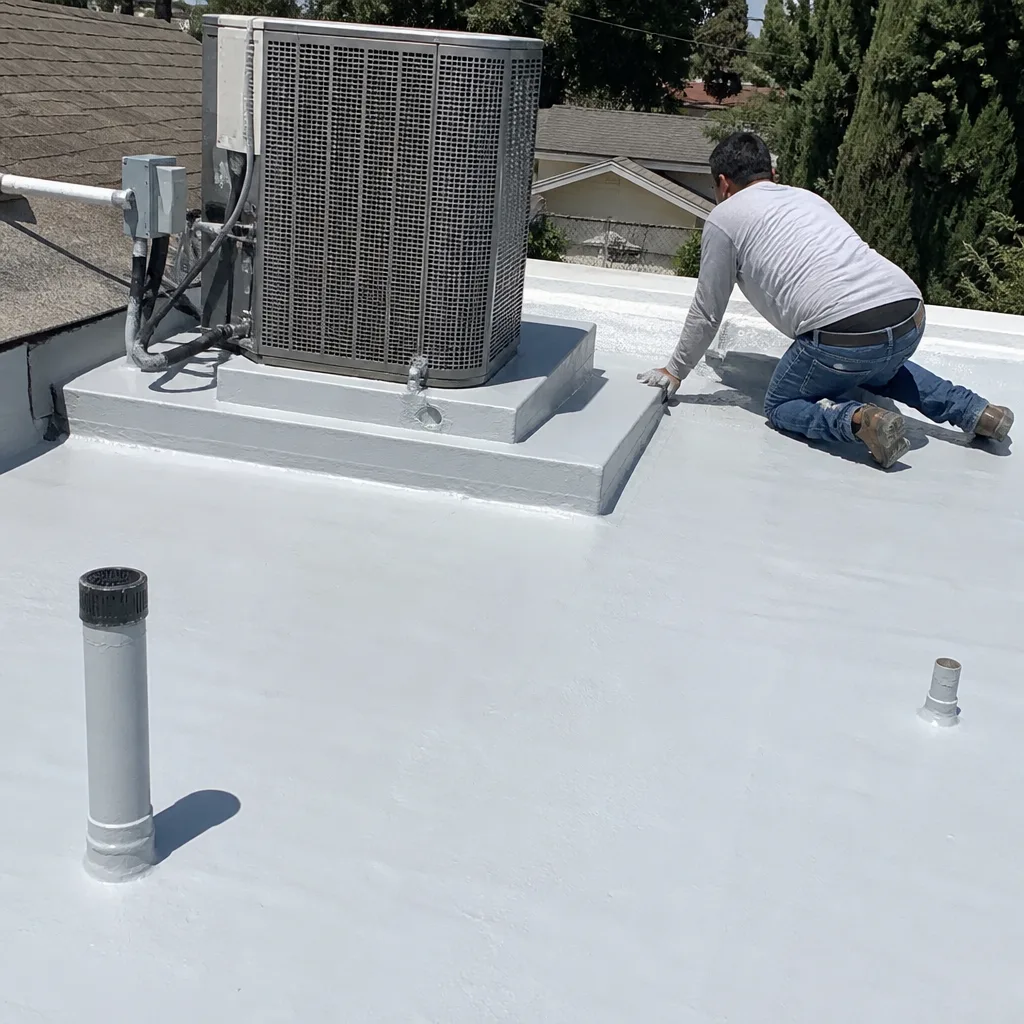
See the difference
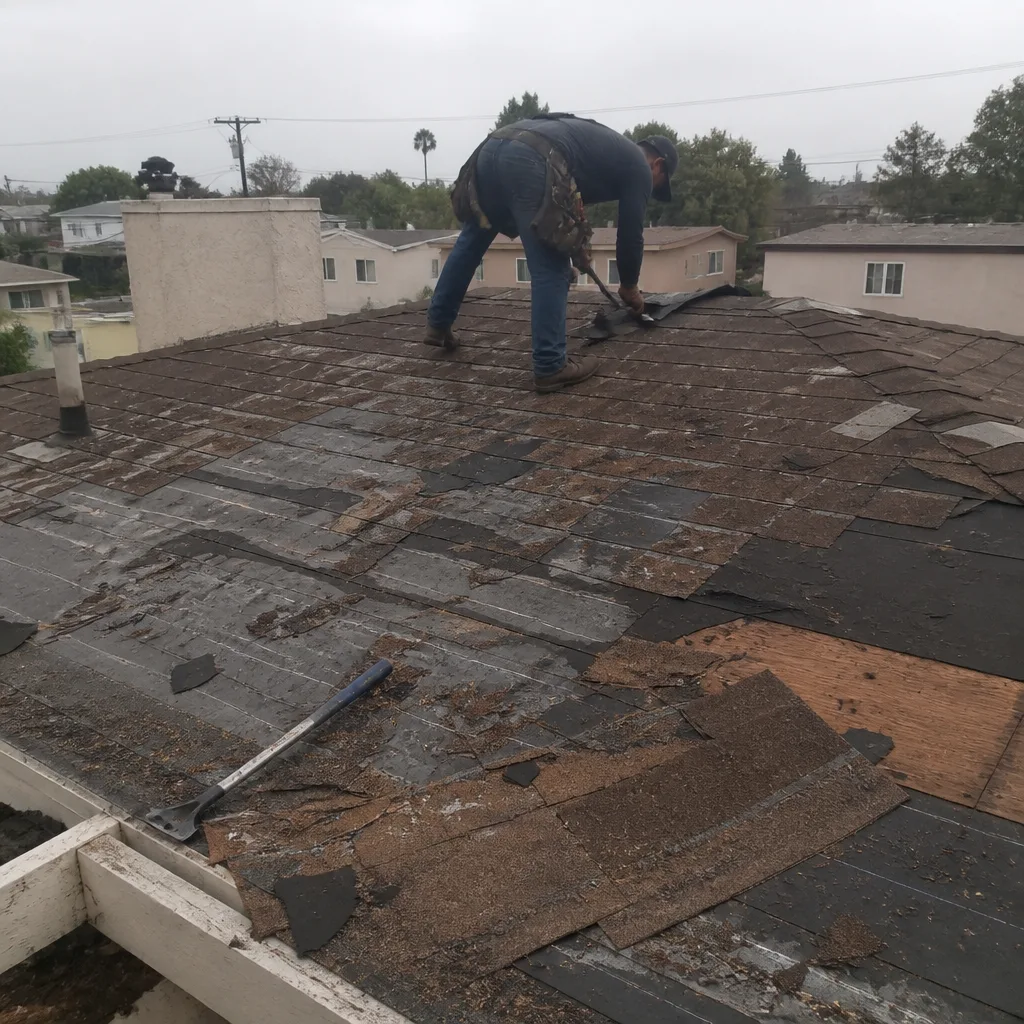 Before
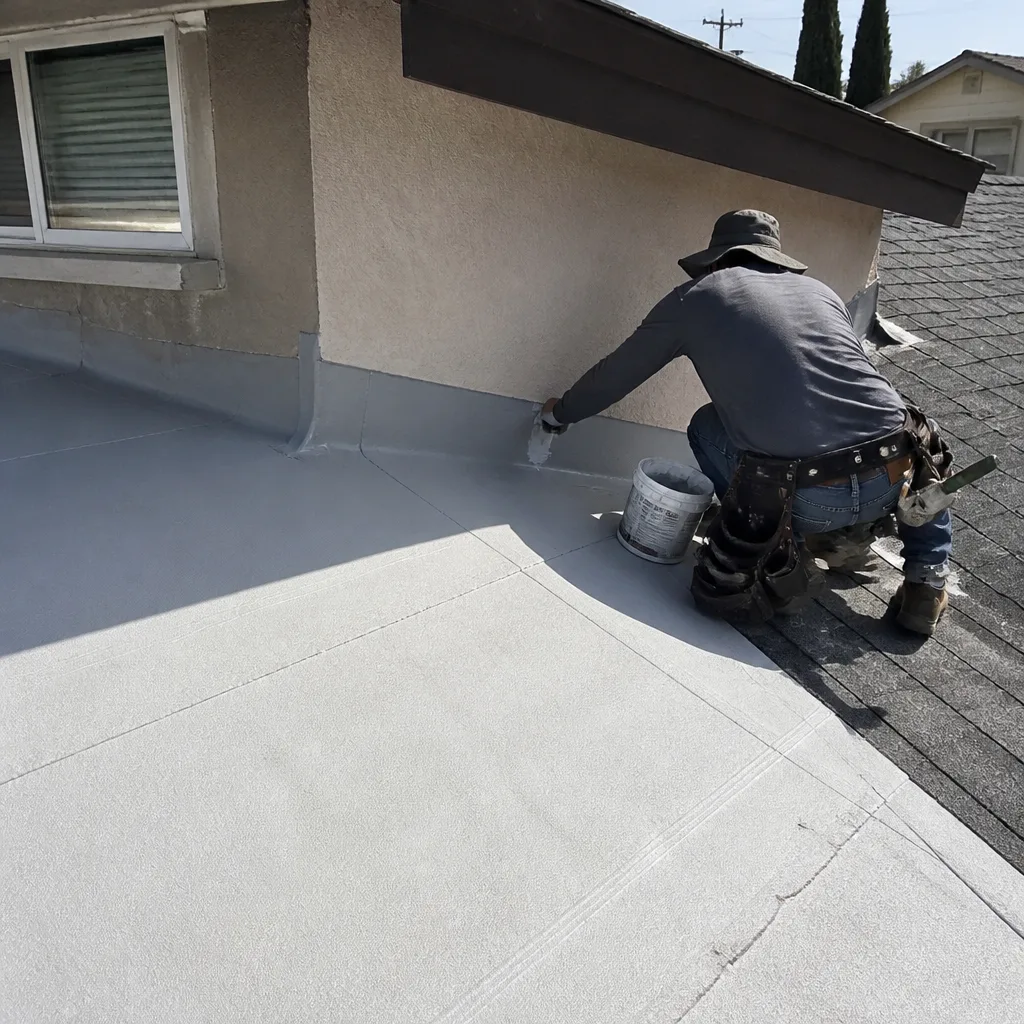 After
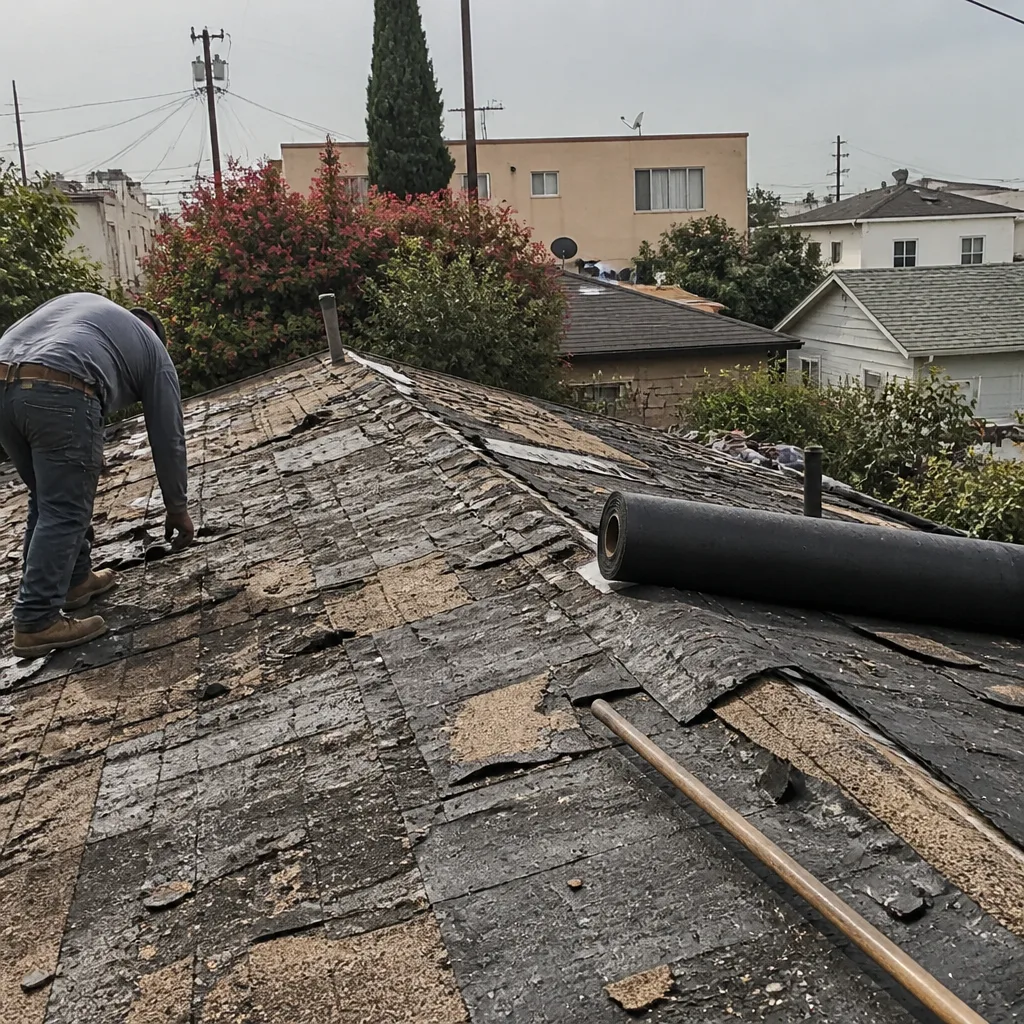 Before
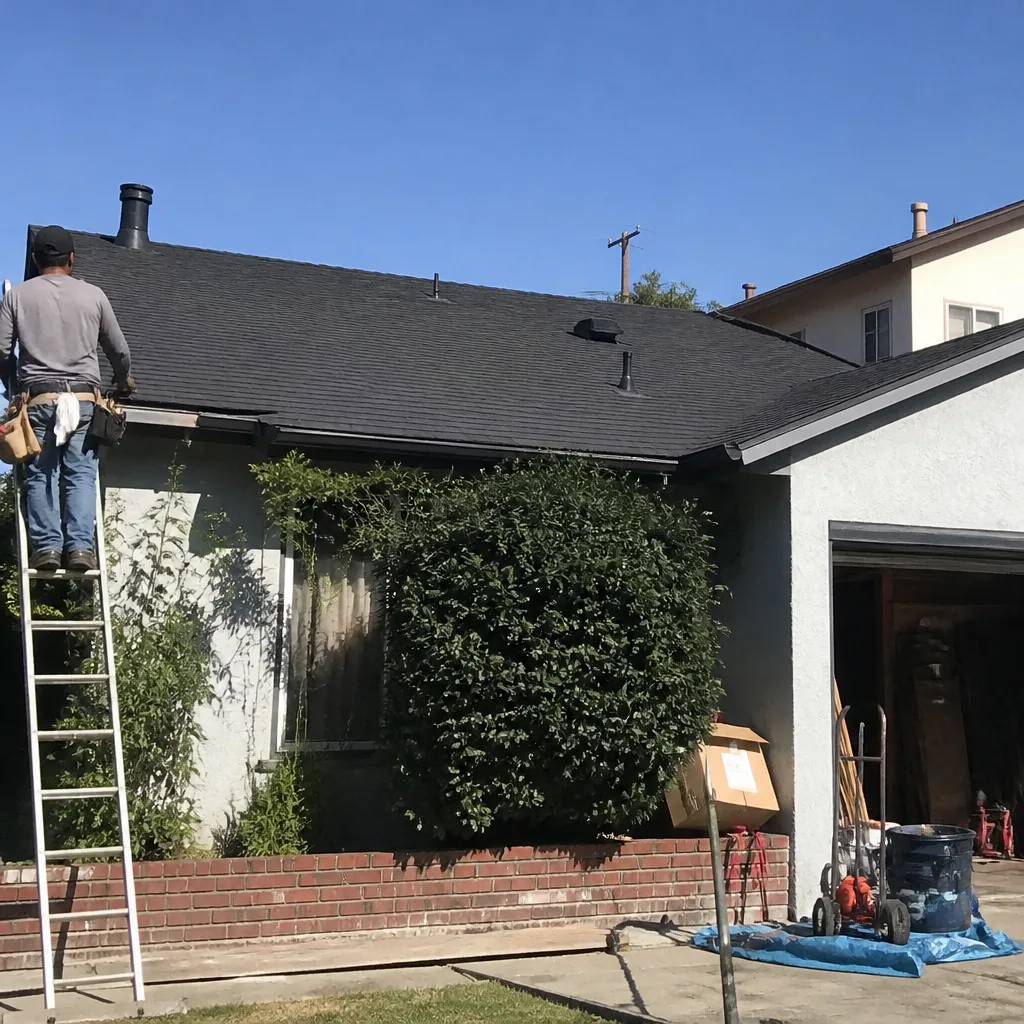 After
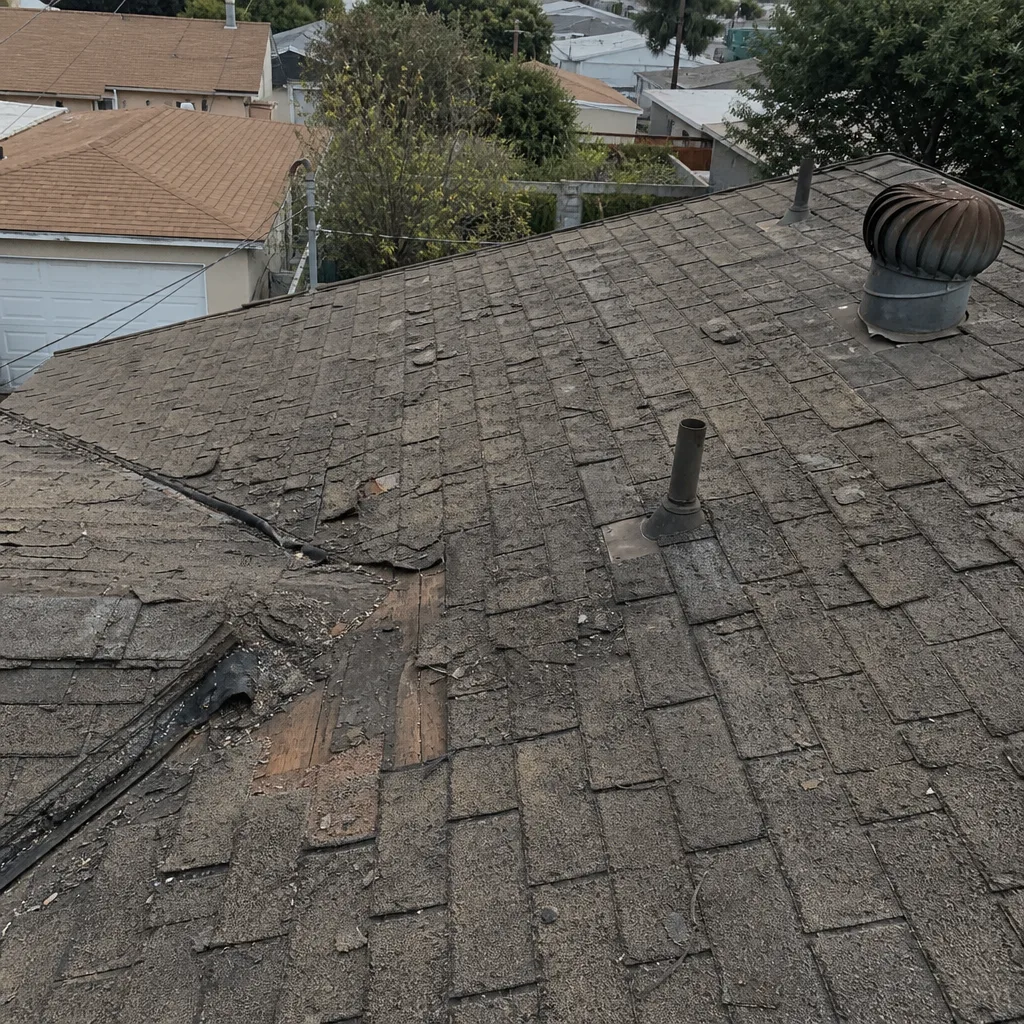 Before
 After
When to Call a Professional
You don’t need to be in the middle of a leak to justify calling a roofer. In fact, the best time to call is before the Koreatown rainy season hits, when contractors are booked solid and you’re stuck waiting. Call if you see water stains on your ceiling, granules piling up in your gutters, or sections of roof where the shingle edges are curling or cracking. Call if you’re buying a building in Koreatown and the inspection flagged roof concerns. Call if your roof is more than 20 years old and you want a professional opinion on remaining lifespan before you list the property. Koreatown Roofing offers free estimates in Koreatown. Call (866) 974-2271 to schedule an inspection, and we’ll walk the roof, assess the condition, and give you a written scope with material options from the manufacturers you already know.
Frequently Asked Questions
A full reroof in Koreatown typically runs between $9,000 and $22,000 for a single-family home, depending on roof size, pitch, tear-off requirements, and material tier. Multi-unit buildings and flat roofs with drainage issues run higher. The material choice (GAF vs. CertainTeed vs. Owens Corning) shifts the number by maybe 10-15%. The biggest variables are access, tear-off complexity, and whether underlying decking needs replacement. Call (866) 974-2271 for an exact quote. Estimates are free.
Yes. The City of Los Angeles requires a permit from LADBS for any reroof, and Koreatown properties are no exception. The contractor should pull the permit, and the permit number should appear in your written contract. Anyone who says a permit isn’t necessary is either misinformed or intentionally avoiding inspection. Unpermitted work becomes your problem at sale, refinance, or insurance claim.
Most single-family roof replacements in Koreatown take three to seven working days from tear-off to final inspection. Dense urban job sites, shared walls, and permit scheduling can extend that. Koreatown Roofing will give you a written timeline in the contract so you’re not guessing when the crew will show up.
Yes. Roof replacement does not require you to move out. The work happens above you, and while it’s loud and there’s dust, the building remains livable throughout. For multi-unit Koreatown buildings, you’ll want to notify tenants in advance, which is exactly the kind of step a contractor with urban job-site experience handles as standard procedure.
Check the CSLB website. Enter the contractor’s license number, verify it’s active, and confirm the business name matches. Then check LADBS’s online records to see their permit history in Los Angeles. A contractor who has pulled permits in LA recently is one who knows the city’s inspection process. A contractor who can’t produce recent permit numbers hasn’t done recent legal work.
Yes, get two or three, but don’t compare the bottom lines directly. Group the bids by manufacturer tier first, then compare the installation scope line by line. A bid with GAF shingles and full ice-and-water shield is not comparable to a bid with off-brand shingles and no underlayment detail. The goal is to compare identical work, and identical work requires the same materials and scope. Call (866) 974-2271 for a written, line-item estimate you can use as a baseline against other bids.
The Bottom Line
Hiring a roofer in Koreatown is less about finding someone who says they can do the job and more about confirming they’ve already done this job in this neighborhood. Check the CSLB license, then dig into LADBS permit history. Ask the urban job-site questions: party walls, street use permits, debris disposal, neighbor notification. Compare bids by normalizing manufacturer tiers, never by bottom-line price. And before you sign anything, get a straight answer on who will actually be on your roof. A roofing specialist who does Koreatown work every day will answer all of these without hesitation. That’s the contractor you want on your building.
Ready to get a written estimate from a roofing-only contractor who knows Koreatown? Call Koreatown Roofing at (866) 974-2271 to schedule your free roof inspection. We’ll walk the property, answer your questions directly, and give you a line-item scope with material options from manufacturers you recognize. Your roof, your material choice.
If you found this guide useful, you may also want to read our detailed breakdowns of Roof Inspection in Koreatown, Roof Repair in Koreatown, and Roof Replacement in Koreatown. For a full overview of who we are and how we work, start at the Koreatown Roofing home page.
Written by the team at Koreatown Roofing, serving Koreatown since 2014.